

Online accounts are vulnerable to phishing, fake websites, and fake logon pages. Users may see websites, messages, social media posts and ads appearing when searching for a Mahadev Book that appear to be authentic but are actually for the purpose of obtaining logon information or personal information from the user.
This Mahadev Book ID Safety Guide lists the things to watch out for to identify suspicious links, fake login pages, how to protect your account and what to do if you think you have been compromised.
Nearly every online account is susceptible to the same forms of security. Always check the authenticity of a service before entering a password, OTP, payment details or personal information and ensure that online gaming is legal in your area.
What Is a Mahadev Book ID?
A Mahadev Book ID can be an account identifier linked to a Internet gaming solution that utilizes the Mahadev Book account name.
An account ID may be helpful in identifying an account. It should not be considered as a password, however.
Users should remember that their account information is confidential. Don’t give out your password, otp, pin, recovery codes, or other authentication information to someone who pretends to be assisting with your account.
The legitimate support person will NOT ask for your password or one-time verification code.
Why Is Mahadev Book ID Safety Important?
Fake login pages mimic the appearance of real login pages.
A scam website can duplicate:
- A website logo
- Brand colors
- Login forms
- Registration screens
- App download buttons
- Customer-support information
- Promotional messages
- Account verification notices
The purpose is typically to get the user to input confidential info.
This information, once it has been sent, can be recorded by the attacker.
This is one of the most important online security habits, and that’s why it’s important to check a link before logging in.
What Is Phishing?
Phishing is a type of scam in which the scammer desperately tries to deceive the victim into divulging his or her personal information.
The attacker can masquerade as a company, site, bank, support team or other trusted service.
A phishing message can contain:
- Verification of your account is required.
- It appears that your login has expired.
- Your account will be suspended.
- You have a special offer!
- Please confirm your payment.
- Download the latest version of the application.
- Contact support immediately.
The message is urgent.
The user clicks on a link and can be directed to a bogus site.
How Fake Mahadev Book Links Can Appear
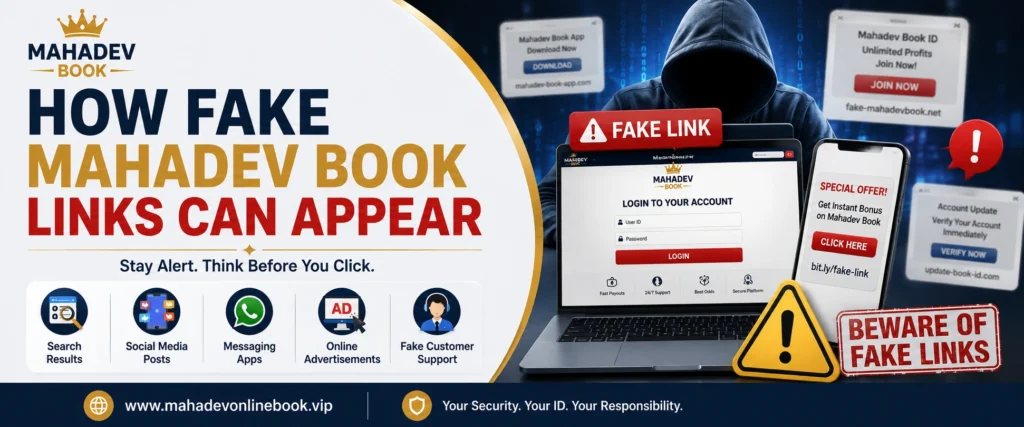
It is advisable for the users to be careful on the links they find on the Internet that is not known from them, because if they use them, they might come across a Mahadev Book ID.
There are many possible locations of the suspicious link.
Search Results
Not all the search results are to be believed.
Some sites and pages may use the names of brands as page titles to draw users to the site. Some might have false information.
Never type in any login information into a website that doesn’t include the domain name.
Social Media
Fake accounts can have recognizable logos.
They can post links to log in, and pretend to be official registration or support.
Beware of using a familiar logo to determine authenticity on social media.
Messaging Apps
Links can be sent to the users via messaging systems.
An account may require ‘immediate verification’.
If the message makes it look urgent, don’t click the link.
Online Advertisements
Sometimes advertisements result in websites that differ from what the users are looking for.
Ensure that you double-check the domain where you are entering sensitive details.
Fake Customer Support
This is yet another prevalent hazard.
A person could get in touch with you and pretend to be an account manager or support representative.
They could ask for your password, OTP, payment details or for remote access to your device.
Don’t give these information.a
How to Identify a Fake Login Page
It can be hard to tell if a fake is a fake, as it mimics the appearance of a real website.
But there are some warning signs that can help.
Check the Domain Name
Pay attention to the web address.
Attackers can set up a domain name that is similar to a known brand.
For instance, a bogus website may:
- Add extra words
- Use unusual spelling
- Add random numbers
- Use unnecessary hyphens
- Take another domain extension.
- Change letters for similar-looking letters
Don’t just take the logo or the design of the page for granted.
One of the essentials to review is the domain.
Look for HTTPS
HTTPS is typically a secure site.
A Padlock icon in the Browser address bar can be observed.
HTTPs does not ensure that a website is legal.
A phishing site can be secure too!
So, there is a need to verify the security connection and the real domain name.
Watch for Poor Grammar
A lot of common frauds have unusual grammar, spelling errors or awkward wording.
For example:
“Your account will be closed today, please verify your account now.”
If it sounds like this, it’s probably a red flag.
But just as grammar does not guarantee the truth of a message, neither does it guarantee that a message is genuine.
A phishing e-mail message can be well written and look professional.
Be Careful With Urgent Messages
Attacks frequently cause a sense of urgency.
A message may say that you only have a few minutes to confirm your account.
Don’t click until you have a moment to spare.
Care still needs to be taken in dealing with a true security problem.
Check the Login Address
Verify the whole website address before keying in your Mahadev Book Login details.
If you accessed this page from an unexpected link, do not type in your password.
Rather, go to the service via an independently verified source.
Never Share Your OTP
One-time passwords are meant to be used to verify access.
If you’re asked for your OTP, it’s a big red flag.
This means those who state they are:
- Customer support
- Account managers
- Payment representatives
- Technical staff
- Administrators
- Friends or agents
OTPs should not be made public.
Do not send it via WhatsApp, Telegram, SMS, email or social media.
Never Share Your Password
Your password should be known only to you.
Do not send it to another person for account verification.
Avoid storing passwords in plain text messages.
Use a strong password that is difficult to guess.
A good password should not contain obvious information such as your name, birthday, phone number, or simple sequences.
Avoid Reusing Passwords
The other security risk is password reuse.
Assume that you’ve used the same password for your Mahadev Book account and email account.
If the password is compromised via another service, an attacker could use it on your other accounts.
Employ different passwords for sensitive services.
This can be easier with a password manager.
Secure Your Email Account
Your email account may be of particular significance.
Protect Your Email Account
Your email account may be of particular significance.
If someone gets into your e-mail account, they could change the password for other accounts.
That’s why you should secure your email with:
- A long, complex password that is different from any other.
- Two factor authentication is used when available.
- Updated recovery information
- Security alerts
- Regular account reviews
Don’t use the same username and password on your email account as you would on other accounts.
Be Careful With the Mahadev Book App
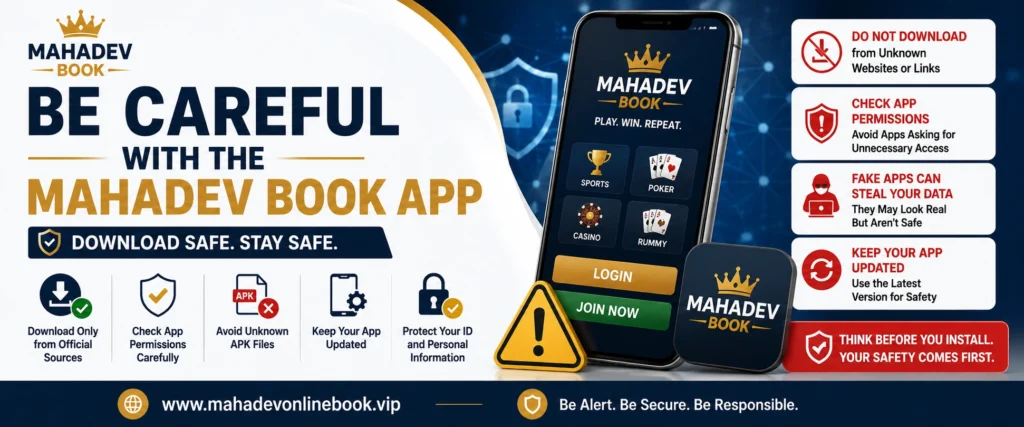
APK files and unofficial downloads are a special concern for users looking for a Mahadev Book App.
Never install any type of application that is sent to you by somebody via a download link.
When installing an app, think about:
- Who was it that sent you the file?
- Does the source appear reliable?
- Does the app ask for undesired permissions?
- Are you sharing the file via an unknown site?
- Is there suspicious activity with the application?
- Does your device security software give you a warning?
Do not turn off device security features to install an application you don’t know.
Why Unknown APK Files Can Be Dangerous
Android APK files can be installed outside the official app ecosystem.
This can create additional security risks.
A malicious APK could potentially contain harmful software.
It may attempt to access:
- Messages
- Contacts
- Files
- Notifications
- Account information
- Device data
The exact risk depends on the application and permissions involved.
Never install an unknown APK simply because someone claims it is the latest version of a Mahadev Book App.
How to Check a Suspicious Link
Follow a few steps before clicking on a link.
Step 1: Stop
Wait before you click.
Step 2: Read the Message
Seek out urgency, extraordinary claims and requests for sensitive information.
Step 3: Inspect the Link
Hover over the link on a computer without clicking it.
If you are using a mobile device, take precautions when clicking or opening links.
Step 4: Check the Domain
Use your eyes to spot off-the-walls spelling, extra words or strange domain names.
Step 5: Verify Independently
If the message claims to be from a service, find the service’s verified contact or website through an independent source.
NEVER use the suspicious message to check the link.
Common Fake Login Warning Signs
A suspicious login page may have several warning signs.
Watch for:
- An unfamiliar domain
- Strange spelling
- Excessive pop-ups
- Automatic downloads
- Unusual redirects
- Poor-quality graphics
- Fake security warnings
- Requests for unnecessary information
- Pressure to provide an OTP
- Requests for remote device access
One warning sign does not always prove fraud.
Several warning signs together should make you stop and verify the website.
What Information Should You Never Share?
Never share sensitive authentication information through unsolicited messages.
This includes:
- Passwords
- OTPs
- PINs
- Recovery codes
- Security questions
- Card PINs
- Banking passwords
- Complete payment credentials
You should also be careful about sharing personal documents with unknown individuals.
Only provide information when there is a legitimate reason and you have verified who is requesting it.
What If You Accidentally Clicked a Fake Link?
Clicking a suspicious link does not automatically mean your account has been compromised.
The next steps depend on what happened.
If you only opened the page and did not enter information or download anything, close it and avoid returning to it.
If you entered your password, change it immediately from a verified website.
If you reused that password elsewhere, change it on those services too.
If you entered payment information, contact your financial institution through its official contact channel.
If you downloaded an unknown application or file, disconnect it from sensitive accounts and run appropriate security checks.
What If You Shared Your Password?
Act quickly.
Change the Password
Use a verified website or official application.
Do not change it through the suspicious link that may have captured your credentials.
Change Reused Passwords
If you used the same password elsewhere, change those accounts too.
Enable Two-Factor Authentication
Where available, enable two-factor authentication.
This adds another layer of protection beyond the password.
Review Account Activity
Look for unfamiliar login activity or account changes.
If you see something suspicious, follow the service’s official account-recovery process.
Protecting Your Mahadevbook ID on Shared Devices
Don’t log onto a very important account on a public computer.
If you need to use a shared device:
- Avoid saving passwords.
- Be sure to not check the box for “Remember Me.”
- Use private browsing, if applicable.
- Log out completely.
- Close the browser.
- Avoid downloading files.
- Do not allow extensions from unknown browsers.
It’s best to use your own device for sensitive activity on your account.
Avoid Remote Access Scams
One can present that he can clear a Mahadev Book Login issue by logging remotely into your computer or on your cell phone.
Be extremely cautious.
Never install software which provides remote access to the computer unless it has been recommended by a person with whom you are familiar.
There is a possibility that someone else can see or operate on your device if you use remote access.
Only use trusted technical support processes.
Keep Your Device Updated
Known vulnerabilities can be fixed by security updates.
Keep your:
- Operating system
- Web browser
- Security software
- Applications
It will be updated when there are valid updates available.
Don’t download software from unknown sources.
Get updates through the normal update process of your device or application.
How to Recognize Fake Customer Support
It’s not unusual for fake support accounts to be targeted to impersonate a brand.
In an effort to verify the identity of a person requesting assistance, a suspicious member of the support staff may:
- Contact you first
- Request to see your password.
- Ask for payment
- Send a shortened link
- Request to have a remote login.
- Commit to reimbursing any lost money
- Urge them to make a quick decision
Avoid disclosing sensitive information.
Check information about support before relying on it.
Mahadev Book Login Safety Checklistz
Before using a Mahadev Book Login page, consider the following:
- Is the website address correct?
- Did you get it from a trusted source?
- Does the page opt to redirect you unexpectedly?
- Does the site need to get unnecessary information?
- Do you have someone else requesting you to provide an OTP?
- Do you see any one asking for your password?
- Does the site have promises that are not achievable?
- Do people insist that you make a quick decision?
If it doesn’t feel right, STOP!
Doing a little more research on the website is better than jeopardizing your account.
Search Results Are Not Proof of Authenticity
One of the little-known facts is that the first website that comes up in search engines is not necessarily the official one.
That’s not necessarily the case.
There are a wide variety of pages that search engines can show.
Some may be advertisements. Others may be websites or pages with similar keywords on other sites.
Always check the destination before inputting information.
Searches for the following are also subject to the same rule:
- Mahadev Book
- Mahadevbook ID
- Mahadev Book App
- Mahadev Book Login
Never take for granted that just because a page ranks high for a keyword, that it is an official page.
How to Build Better Online Security Habits
Reliable security is good habits.
These habits should be a part of your daily routine:
Verify Before You Trust
Do not trust a link simply because it looks professional.
Think Before You Click
Unexpected links deserve extra attention.
Keep Credentials Private
Never give out passwords or OTPs.
Use Strong Passwords
Make different passwords for critical accounts.
Enable Extra Security
Always and when possible use 2 factor authentication.
Update Your Devices
Keep software updated.
Avoid Unknown Downloads
Avoid installing unknown apps and APK files.
Monitor Your Accounts
Know about unusual activity.
Final Thoughts
Basic online security measures are the first steps in protecting a Mahadev Book ID. It is possible to get confused in the distinction between genuine services and scams, due to fake links, phishing pages, fraudulent support accounts, and malicious applications.
The basic rule is to never give your password, OTP, PIN or recovery code to anyone.
Make sure to always verify the website URL before accessing Mahadev Book Login. When it comes to emails, messages and social media links, be cautious. Don’t download or install apps from unknown sources or unofficial sources.
In the event of some sensitive information being accidentally supplied, take action immediately. Update exposed passwords, protect connected accounts, monitor activity and reach out to the service or financial institution via a trusted channel.
Last but not least, don’t assume that a website’s appearance means that it is legitimate. A professional logo or familiar brand name, or almost any HTTPS connection can be copied. Always verify before entering sensitive information.