

Teen patti is an ancient Indian card game, well known for its easy mechanics and hand rankings of three cards. Reading the rules, combinations and common pitfalls can help readers get to know the game before deciding whether or not to play.
This Mahadev Book Teen Patti Guide explains the fundamentals of playing teen patti, hand rankings, key terms, probability and common beginner errors. It also covers some general safety precautions in regard to searches on Mahadev book, Mahadev book login, Mahadev book ID and Mahadev book app.
The guide is designed to be used for educational purposes only. The rules of the games differ among versions, and it makes sense to read the rules of the game that has been played in the area before using any online money-based gaming service.
What Is Teen Patti?
The game of Teen Patti is a three-card game that is typically played with a standard 52-card deck, with no jokers included. Each player is dealt 3 cards and the value of each hand is based on the ranking system employed in that version.
The game can be played in various formats. Some versions feature betting rounds and others have simplified rules. The online variants can also have different interfaces, settlement procedures and rules.
To begin with, it is important to know the traditional rules of Mahadev Book Teen Patti before assuming the rules of all the versions found online are the same.
Basic Rules of Teen Patti
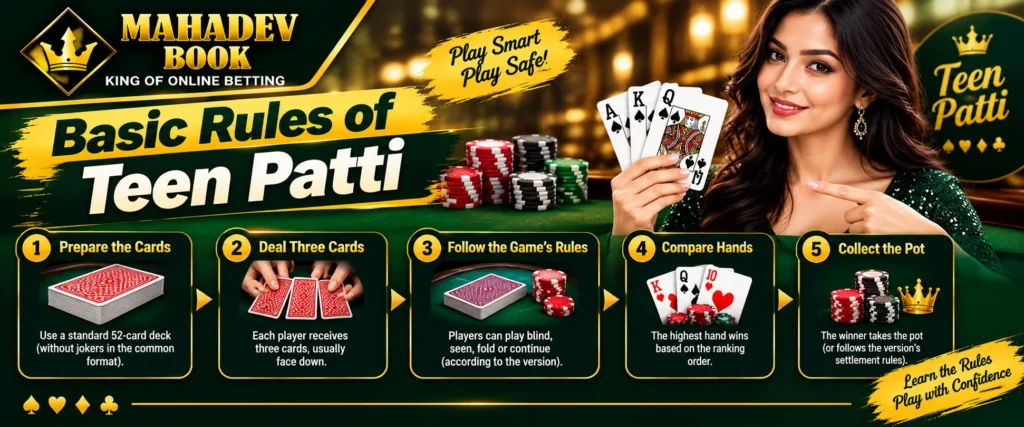
The traditional game is usually played in this manner although the specifics may differ.
1. Prepare the Cards
There are 52 cards in a standard deck that are divided into four suits: hearts, diamonds, clubs and spades. There are 13 ranks (Ace to King) in each suit.
2. Deal Three Cards
Each player receives three cards according to the selected version’s rules. In traditional play, the cards are dealt face down.
3. Understand the Hand Ranking
Three cards are given to each player, based on the rules of the version selected. Traditional play is where cards are dealt face down.
4. Follow the Game’s Procedures
Depending on the variant, players can hold or fold, continue a round, or play blind. Each of these terms has a specific definition as part of the rules; novices should read the full instructions first before entering.
5. Determine the Result
This will depend on hand rankings and any other rules (including tie-breakers). The rules for special sequences and ace combinations may be different in some versions.
Important: Do not rely on a short description alone when the game’s own rules are available. A small rule variation can change how a hand is evaluated.
Teen Patti Hand Rankings Explained
Hand rankings are central to understanding Teen Patti. The following table shows a commonly used ranking order from strongest to weakest.
| Rank | Hand Type | Meaning | Example |
|---|---|---|---|
| 1 | Trail or Three of a Kind | Three cards of the same rank | A♠ A♥ A♦ |
| 2 | Pure Sequence | Three consecutive cards of the same suit | 4♥ 5♥ 6♥ |
| 3 | Sequence | Three consecutive cards of different suits or not all the same suit | 7♠ 8♥ 9♦ |
| 4 | Color | Three cards of the same suit that do not form a sequence | 2♣ 6♣ J♣ |
| 5 | Pair | Two cards of the same rank | K♠ K♦ 5♥ |
| 6 | High Card | A hand that does not form any of the above combinations | A♠ 9♦ 4♣ |
The precise order of special sequences, including certain ace-high or ace-low combinations, can depend on the version being played. Always check the rules provided for the specific game.
1. Trail or Three of a Kind
A trail contains three cards of the same rank. For example, three kings form a trail.
In common Teen Patti ranking systems, a trail is the strongest standard hand category. When two players have trails, the comparison rules determine which hand is higher.
2. Pure Sequence
A pure sequence consists of three consecutive cards from the same suit. For example, 4♥, 5♥, and 6♥ form a pure sequence.
It is generally ranked below a trail and above an ordinary sequence.
3. Sequence
A sequence consists of three consecutive cards that are not all from the same suit. For example, 7♠, 8♥, and 9♦ form a sequence.
The ranking of particular sequences may depend on the rules, especially when aces are involved.
4. Color
A color contains three cards of the same suit that do not form a sequence. For example, 2♣, 6♣, and J♣ form a color.
A color is generally ranked below a sequence and above a pair.
5. Pair
A pair contains two cards of the same rank and one unrelated card. For example, K♠, K♦, and 5♥ form a pair.
When two players have pairs, the pair rank and then the remaining card may be used to compare hands, depending on the rules.
6. High Card
A high-card hand does not match any of the higher-ranking categories. The cards are compared according to the game’s ranking and tie-breaking rules.
A high card is the lowest standard hand category in the common ranking system described above.
Important Teen Patti Terms for Beginners
Learning common terminology makes the game easier to understand.
- Blind: Playing without looking at your cards, where this option is permitted.
- Seen: Playing after looking at your cards.
- Fold: Leaving the current round according to the game’s rules.
- Boot amount: An initial contribution required in some traditional formats.
- Pot: The total amount accumulated during a round in formats that involve contributions.
- Show: A comparison of hands under the game’s rules.
- Trail: Another term for three of a kind.
- Pure sequence: Three consecutive cards of the same suit.
These terms do not necessarily apply to every digital version. The instructions for a particular game should take priority over general definitions.
Common Teen Patti Mistakes to Avoid
Beginners often misunderstand hand rankings or assume that previous outcomes can predict future cards. The following mistakes are worth recognising.
1. Learning the Rankings Incorrectly
Confusing a pure sequence with an ordinary sequence can lead to incorrect assumptions about a hand’s strength.
Better approach: Review the full hand-ranking order and practise identifying sample combinations without wagering money.
2. Assuming a Strong Hand Guarantees a Result
In a hand, a player does not necessarily win all of the rounds. This will be determined based on the other hands and rules being used.
Better approach: View rankings as a means to understand the game and not as a commitment to a certain result.
3. Believing Previous Results Predict Future Cards
Players sometimes believe that a certain card or hand is “due” after several different outcomes. This is not a reliable way to predict a future deal.
Better approach: Understand that previous results do not, by themselves, establish what will happen in a new round.
4. Ignoring Version-Specific Rules
In some cases after a number of different outcomes, players think that they are getting a certain card or hand “due.” It is not a good indicator of a future deal.
Better approach: know that past outcomes do not guarantee the outcome for a new round.
5. Following Unverified Advice
Online posts may claim that a particular sequence, timing method, or pattern guarantees success. Such claims should be treated cautiously.
Better approach: Look for clear explanations of the rules and probability instead of relying on guaranteed-win claims.
6. Overlooking Financial Risk
Money-based gaming can lead to losses, and there is no strategy that guarantees a profit.
Better approach: Learn the rules through non-monetary examples where possible, and do not use borrowed money or money needed for essential expenses.
Understanding Teen Patti Probability
Probability describes how likely an outcome is under defined conditions. In Teen Patti, possible hands are formed from combinations of three cards, so different hand categories occur at different frequencies.
For example, a trail is much less common than a high-card hand in a standard three-card deal. However, knowing that a hand is rare does not guarantee that it will appear in a particular round.
A few useful principles are:
- Rare does not mean guaranteed: An uncommon hand may not appear during a particular session.
- Past results are not a prediction: Previous rounds do not automatically determine the next deal.
- Rules affect comparisons: Special sequences and tie-breakers can change how hands are evaluated.
- Probability is not a profit forecast: Understanding the mathematics does not remove the financial risks of money-based play.
For learning purposes, hand combinations can be studied with examples, charts, or card simulations that do not involve real-money participation.
Mahadev Book Login: General Safety Considerations
When looking for Mahadev Book Login details, one should pay attention as to where they enter the details. The presence of a familiar logo or page design does not automatically mean that a web page is genuine.
Consider these general security practices:
- Check the full website address for misspellings and unexpected domain changes.
- Avoid login links received through unsolicited messages or unknown social-media accounts.
- Never share passwords, OTPs, or account recovery codes.
- Avoid saving credentials on public or shared devices.
- Stop if a page redirects unexpectedly or requests unusual permissions.
- Verify the identity of the service and its legal status before sharing personal or financial information.
HTTPS indicates that a connection is encrypted, but it does not independently prove that a website is trustworthy or legally authorised.
How to Protect Your Mahadev Book ID
A Mahadev Book ID can be an account identifier of the Service. Account ID is not a password, OTP or recovery code.
To reduce common security risks:
- Use a strong, unique password for each account.
- Keep OTPs and recovery codes private.
- Avoid sharing account access with strangers or people claiming to be agents.
- Be cautious when asked to submit identity documents or payment details through unofficial channels.
- Review account activity where security tools are available.
- If you suspect unauthorised access, stop using suspicious links and seek help through a support channel you have independently verified.
No single measure guarantees complete security. Protecting personal information also requires checking the legitimacy of the service itself.
What to Check Before Installing a Mahadev Book App
Before installing a Mahadev Book App or any other gaming application, review its source and permissions carefully.
| Check | What to Look For |
|---|---|
| Source | Verify the publisher and the source of the installation file. |
| Permissions | Question requests for access unrelated to the app’s stated function. |
| Privacy policy | Review how personal data may be collected, stored, or shared. |
| Updates | Avoid unexpected update files and unverified APK downloads. |
| Account protection | Never share passwords or OTPs with people offering installation help. |
| Legal status | Check the current laws that apply to the service and your location. |
Do not disable your device’s security protections simply to install an unfamiliar app. If an application requests unnecessary permissions or encourages you to share sensitive details through unofficial channels, stop and investigate.
Frequently Asked Questions
1. What are the main Teen Patti hand rankings?
The most common ranking order is trail, pure sequence, sequence, color, pair, high card, in order of strength. Varying versions may have different specific ace combinations and tie-breakers.
2. Is a pure sequence stronger than a trail?
No, a trail or three of a kind is more valuable than a pure sequence in the common ranking system.
3. Can previous Teen Patti results predict the next hand?
You can’t predict from past results. Remember that just because something has happened once doesn’t mean it will happen again.
4. What should beginners learn first?
Begin by giving an introduction to the hand rankings, card values, common terms, and rules of the version being studied. Options such as non-monetary examples can help clarify the game without risk of losing money.
5. How can I approach Mahadev Book Login safely?
Before entering credentials, check the address of the website and identity of the service. Resist unexpected links, don’t share OTPs and verify the legal status of the service before entering personal data.
6. How do I protect my Mahadev Book ID?
Make sure you use a different password, don’t share a recovery password, don’t use unsolicited support numbers, and check for account activity if it is possible.
7. What should I check before using a Mahadev Book App?
Read the installation source, publisher, permissions, privacy policy and legal requirements. Don’t install apps from networks you don’t know and don’t let them turn off the security on your device.
Conclusion
Once the basic rules of teen patti, hand rankings, and the terminology are understood, it becomes easier to comprehend. The understanding of the difference between a trail, pure sequence, sequence, color, pair and high-card hand can help explain the traditional 3-card comparisons.
This Mahadev Book Teen Patti Guide also outlines some of the misconceptions about probability and the need for online safety. When looking for Mahadev Book, Mahadev Book Login, Mahadev Book ID or Mahadev Book App, readers should check the information they are seeking is valid, keep their personal data safe and ensure they are familiar with the local laws governing their search. There is no hand ranking or strategy that can ensure a player is always going to win or reduce the risks of playing with money.